Choosing a dumpster sounds simple until you’re asked what size you want.
Do you need 10 yards? Is 20 yards enough? Would renting a 30-yard dumpster be safer? And what exactly does “20 cubic yards” of junk look like in the real world?
If you’ve found yourself asking “What size dumpster do I need?”, you’re definitely not alone.
Choosing the right roll-off dumpster is important because going too small can result in additional hauls, while renting much more capacity than you need may mean paying for space you never use.
For Albuquerque homeowners, contractors, property managers, and businesses, the best dumpster size comes down to four main factors: the amount of debris, the type of material, the size of the project, and the weight of the waste.
This residential and construction dumpster size guide will help you understand the differences so you can make a more informed choice before your container arrives.
Understanding Dumpster Rental Sizes in Albuquerque
Roll-off dumpster capacity is measured in cubic yards.
A 20-yard dumpster, for example, can hold approximately 20 cubic yards of material by volume.
That doesn’t necessarily mean you can fill every 20-yard dumpster completely with any material you want. Weight is just as important as volume.
Light materials such as old furniture may fill a container without approaching its weight allowance. Concrete, dirt, roofing materials, and masonry are much denser and can reach weight limits long before a dumpster looks full.
That’s why choosing among dumpster rental sizes in Albuquerque requires thinking about what you’re throwing away—not simply how big the pile looks.
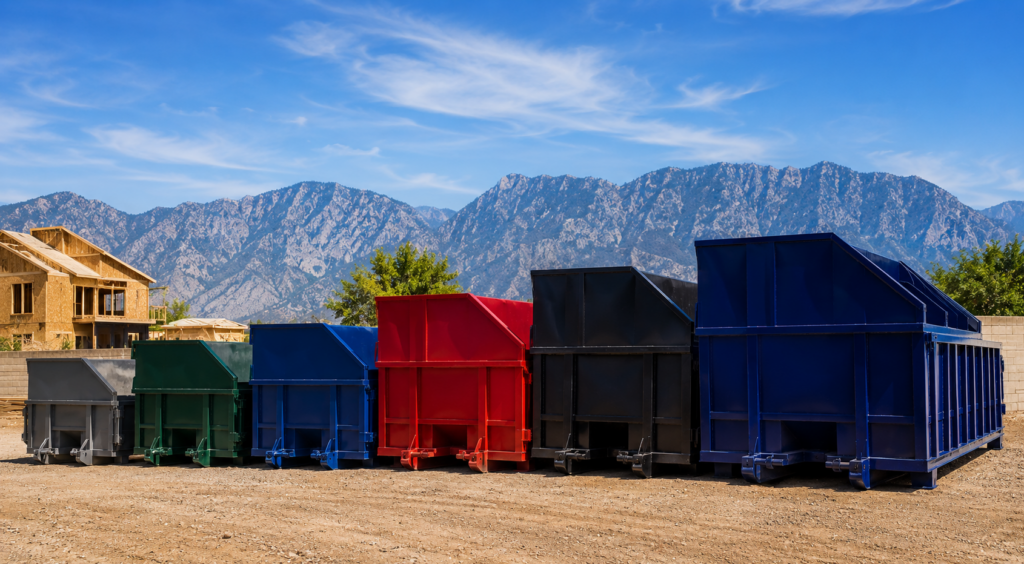
Common roll-off dumpster capacities include:
- 10-yard dumpsters
- 15-yard dumpsters
- 20-yard dumpsters
- 25-yard dumpsters
- 30-yard dumpsters
- 40-yard dumpsters
Exact container dimensions can vary, so ask your rental provider about the dimensions of the specific container being delivered.
10-Yard Dumpster: Best for Smaller Albuquerque Projects
A 10-yard dumpster is one of the smallest commonly available roll-off containers.
As a rough visualization, 10 cubic yards is comparable to approximately 3 to 4 pickup-truck loads of debris, although the actual number varies considerably based on the truck, material, and how everything is loaded.
What Is a 10-Yard Dumpster Good For?
A 10-yard container can work well for:
- Small garage cleanouts
- Attic cleanouts
- Minor bathroom renovations
- Small flooring projects
- Light landscaping cleanup
- Small amounts of remodeling debris
- Decluttering projects
Its smaller footprint can also make it easier to place on properties where space is limited.
When Is a 10-Yard Dumpster Too Small?
A 10-yard dumpster can become undersized quickly during a whole-home cleanout or substantial remodeling project.
Large furniture, cabinets, bulky demolition materials, and construction waste consume space faster than many people expect.
If your project could expand after work begins, moving up a size may give you more flexibility.
15-Yard Dumpster: A Step Up for Residential Cleanups
A 15-yard dumpster provides approximately 50% more volume than a 10-yard container while remaining relatively compact.
Think of it as roughly 4 to 6 pickup-truck loads as a general visualization rather than an exact conversion.
Common Uses for a 15-Yard Dumpster
A 15-yard dumpster can be useful for:
- Garage cleanouts
- Basement or storage cleanouts
- Small kitchen renovations
- Flooring removal
- Yard cleanup
- Small roofing jobs
- Moving cleanouts
For homeowners who suspect a 10-yard container may be slightly too small, the 15-yard option can provide useful extra capacity without jumping to a large construction container.
10 Yard vs 20 Yard Dumpster: Which Should You Choose?
One of the most useful comparisons for homeowners is the 10 yard vs 20 yard dumpster.
The difference is significant: a 20-yard dumpster offers roughly twice the volume of a 10-yard dumpster.
Choose a 10-yard dumpster when you’re dealing with a clearly defined, relatively small amount of debris.
Consider a 20-yard dumpster when you’re:
- Cleaning multiple rooms
- Removing bulky furniture
- Remodeling a larger area
- Removing a deck
- Tackling a substantial landscaping project
- Unsure whether 10 yards will be enough
If you’re right on the edge between the two, ask your rental provider about pricing and your expected material. Paying for the appropriate container from the beginning may be more economical than discovering halfway through the project that another haul is required.
20-Yard Dumpster: A Versatile Choice for Albuquerque Homes
For many residential projects, the 20-yard dumpster is a useful middle-ground option.
It offers significantly more capacity than smaller containers without moving immediately into the largest commercial and construction dumpster sizes.
A 20-yard dumpster represents roughly 6 to 8 pickup-truck loads as a broad visualization.
What Fits in a 20-Yard Dumpster?
Depending on weight restrictions and local disposal rules, a 20-yard dumpster may accommodate debris from projects such as:
- Larger garage cleanouts
- Home decluttering
- Flooring removal
- Kitchen renovations
- Bathroom remodeling
- Deck removal
- Furniture disposal
- Landscaping projects
- Smaller construction projects
This versatility is why people comparing residential dumpster rental sizes in Albuquerque frequently consider a 20-yard container.
Is a 20-Yard Dumpster Big Enough for a Home Remodel?
It depends on the remodel.
A 20-yard dumpster can work very well for a kitchen, bathroom, flooring, or targeted renovation. A whole-house remodel involving extensive demolition could require a 30- or 40-yard dumpster—or multiple hauls.
Before ordering, estimate which materials are being removed rather than relying only on the square footage of the house.
25-Yard Dumpster: Extra Room Without Going Too Large
A 25-yard dumpster fills the gap between medium residential containers and larger construction dumpsters.
It can hold roughly 8 to 10 pickup-truck loads of debris as a general comparison.
Good Projects for a 25-Yard Dumpster
Potential applications include:
- Multi-room renovations
- Large household cleanouts
- Estate cleanouts
- Office cleanouts
- Larger roofing projects
- Property turnover projects
- Moderate construction work
For projects where a 20-yard dumpster looks slightly tight, a 25-yard container can provide additional breathing room.
30-Yard Dumpster: Popular for Construction and Major Renovations
Once you get into major remodeling and construction work, 30-yard dumpsters become particularly useful.
A 30-yard dumpster represents approximately 10 to 12 pickup-truck loads of material as a rough volume comparison.
Common Uses for a 30-Yard Dumpster
These include:
- Major home renovations
- Home additions
- New construction
- Large estate cleanouts
- Commercial renovations
- Building cleanouts
- Demolition projects
- Larger contractor jobs
The extra capacity makes a 30-yard dumpster useful when crews are generating significant quantities of bulky debris.
40-Yard Dumpster: Maximum Capacity for Large Projects
A 40-yard dumpster is among the largest standard roll-off containers used for construction and commercial projects.
As a broad visualization, it can represent roughly 12 to 16 pickup-truck loads of debris.
When Do You Need a 40-Yard Dumpster?
Typical applications include:
- Major commercial renovations
- Large building cleanouts
- Warehouse cleanouts
- Large-scale construction
- Major demolition
- Commercial property renovations
- High-volume bulky debris
A 40-yard container offers substantial volume, but bigger isn’t automatically better.
Dense materials can make a large dumpster impractical because the weight limit may be reached long before the container is physically full.
Construction Dumpster Sizes: Choosing for a Job Site
Contractors need to consider dumpster selection differently from homeowners.
Construction projects often generate a combination of:
- Lumber
- Drywall
- Siding
- Flooring
- Roofing materials
- Cabinets
- Fixtures
- Packaging
- Demolition debris
The volume can increase very quickly.
Small Construction and Remodeling Jobs
A 10-, 15-, or 20-yard dumpster may be appropriate for a smaller renovation or clearly defined amount of debris.
Medium Construction Projects
A 20-, 25-, or 30-yard dumpster may work better for larger renovations, additions, and substantial cleanouts.
Large Construction and Demolition
A 30- or 40-yard dumpster may provide the capacity needed for high-volume debris.
The type of debris still matters. Large-volume containers are excellent for bulky materials, but extremely heavy debris may require a different strategy.
What Size Dumpster Do I Need for Roofing?
Roofing deserves special attention because shingles are heavy.
You shouldn’t choose a roofing dumpster based entirely on volume.
Factors include:
- Roof size
- Number of shingle layers
- Roofing material
- Container weight allowance
A dumpster can appear only partially full while already containing a substantial amount of weight.
Tell Jackson Compaction that you’re disposing of roofing materials when ordering so the appropriate container and loading guidance can be recommended.
What Size Dumpster Do I Need for Concrete?
Concrete presents the same issue at an even greater scale.
Concrete, brick, dirt, stone, and similar materials are extremely dense.
A large 40-yard dumpster filled with concrete could become far too heavy for safe transportation. Heavy debris therefore may need a smaller container, restricted fill level, or designated heavy-material dumpster.
Never assume that a dumpster can be filled to the top with concrete simply because the material physically fits.
Discuss heavy debris with your rental provider before loading.
Residential Dumpster Size Guide for Albuquerque Homeowners
If you’re still wondering what size dumpster you need, this simplified residential dumpster size guide can help.
Small Cleanout
Consider: 10–15 yards
Examples:
- Closet cleanout
- Garage decluttering
- Small bathroom project
Medium Cleanup or Remodel
Consider: 15–20 yards
Examples:
- Kitchen remodel
- Flooring replacement
- Larger garage cleanup
- Furniture removal
Large Residential Project
Consider: 20–30 yards
Examples:
- Estate cleanout
- Multi-room renovation
- Large deck removal
- Home addition
Major Renovation
Consider: 30–40 yards
Examples:
- Whole-house remodeling
- Major demolition
- Large property cleanout
These are general guidelines. Your debris type and weight can change the recommendation.
Don’t Forget About Bulky Items
Volume isn’t determined by weight alone.
A couch may not weigh nearly as much as a pile of concrete, but it consumes a tremendous amount of space.
Bulky items include:
- Sofas
- Mattresses
- Dressers
- Cabinets
- Large shelving
- Carpeting
Breaking down approved materials when practical can help use container space more efficiently.
Weight Matters as Much as Dumpster Size
This is one of the most important things to understand when renting a dumpster.
Dumpster size measures volume. Weight limits determine how heavy the loaded container can safely be.
The two are not interchangeable.
Light debris may completely fill a dumpster without creating a weight problem.
Heavy debris can exceed allowable weight while occupying only a fraction of the available volume.
Common heavy materials include:
- Concrete
- Dirt
- Brick
- Asphalt
- Roofing shingles
- Tile
Tell the rental company exactly what you plan to dispose of when requesting your dumpster.
What Happens If My Dumpster Goes Over Weight?
If the loaded dumpster exceeds the weight included in your rental agreement, additional charges may apply.
More importantly, severely overloaded containers can create transportation and safety problems.
You can reduce the risk of an overweight dumpster by:
- Explaining your project when ordering.
- Identifying heavy materials in advance.
- Following loading instructions.
- Never exceeding the container’s fill line.
- Asking before mixing unusually dense debris with general waste.
Getting the correct container from the beginning is much easier than addressing an overloaded dumpster afterward.
Don’t Overfill Your Dumpster
Physical overfilling is different from exceeding the weight allowance.
Waste generally should not stick above the top of a roll-off dumpster.
Items extending beyond the container can shift or fall during transportation, creating a serious safety hazard.
Avoid balancing items on top because you’re trying to squeeze in “just one more thing.”
If you run out of room, contact your dumpster provider and discuss the safest solution.
How Long Can I Keep a Dumpster?
Rental periods vary by provider and service agreement.
Jackson Compaction offers 30-day dumpster rentals, giving customers time to complete many residential, construction, and commercial projects without feeling pressured to finish everything in a weekend.
That can be particularly useful for:
- Remodeling projects
- Construction jobs
- Estate cleanouts
- Property renovations
- Large household cleanups
If your project could exceed your rental period, discuss extensions and associated charges before the original rental expires.
Where Should I Put My Roll-Off Dumpster?
Choosing the right dumpster size also means making sure you have enough room for delivery.
A roll-off truck needs space to:
- Approach the site
- Maneuver safely
- Lower the container
- Retrieve it later
Potential placement areas include:
- Driveways
- Construction sites
- Commercial lots
- Designated private property areas
Watch for overhead obstacles such as:
- Power lines
- Tree branches
- Roof overhangs
You should also consider access. A dumpster placed too far from the work area can add unnecessary labor to every load of debris.
Do I Need a Permit for a Dumpster in Albuquerque?
Permit requirements can depend on where the dumpster will be located.
A container placed entirely on private property may be treated differently from one occupying a public street, sidewalk, or right-of-way.
If public property will be involved, verify current requirements with the appropriate local authority before delivery.
Don’t assume that rules for one property automatically apply to another.
Common Dumpster Sizing Mistakes
Mistake #1: Choosing Based Only on Price
The smallest dumpster isn’t necessarily the least expensive solution if it requires another haul.
Consider total project needs rather than just the initial rental price.
Mistake #2: Underestimating Bulky Waste
Furniture and demolition debris consume space surprisingly quickly.
Mistake #3: Ignoring Weight
This is especially important for roofing, concrete, dirt, masonry, and tile.
Mistake #4: Ordering a Huge Dumpster “Just in Case”
Going too large isn’t always necessary. A knowledgeable rental provider can help you find a more appropriate balance.
Mistake #5: Not Explaining the Project
“Send me a dumpster” gives the rental company very little information.
Instead, explain that you’re:
- Remodeling a kitchen
- Removing a roof
- Cleaning an estate
- Demolishing a deck
- Cleaning a warehouse
That context makes it much easier to recommend an appropriate size.
How to Estimate the Dumpster Size You Need
You don’t need to calculate every piece of debris.
Instead, work through these questions:
1. What kind of project is it?
A garage cleanout produces very different waste than a roofing project.
2. How much material is being removed?
Think about the actual items or building materials being discarded.
3. Is the material bulky?
Furniture and cabinets require substantial volume.
4. Is it heavy?
Concrete and shingles can create weight issues.
5. Could the project grow?
Renovations have a habit of uncovering additional work.
Once you have those answers, describe the project to your dumpster rental company.
10 Yard vs 20 Yard vs 30 Yard Dumpster
Here’s a simple way to think about three popular capacities:
| Dumpster Size | Approx. Pickup Loads* | Common Uses |
|---|---|---|
| 10 Yard | 3–4 | Small cleanouts, minor renovations |
| 20 Yard | 6–8 | Remodels, furniture, residential cleanouts |
| 30 Yard | 10–12 | Major renovations, construction, estate cleanouts |
*Pickup-load comparisons are approximate visualizations only. Actual capacity varies based on truck size, debris type, loading method, and weight restrictions.
If you’re between sizes, consider both the amount and type of material before making your decision.
Albuquerque Construction Dumpster Rentals for Contractors
For contractors, reliable waste removal isn’t simply a convenience. It affects job-site organization and productivity.
An undersized dumpster can:
- Fill too quickly
- Require additional hauling
- Create debris piles
- Interrupt workflow
An appropriately sized construction dumpster gives crews a central location for approved waste and helps maintain a cleaner job site.
Jackson Compaction provides roll-off dumpster options for Albuquerque contractors handling construction, remodeling, demolition, roofing, and other projects.
Albuquerque Residential Dumpster Rentals for Homeowners
You don’t need to be a contractor to rent a roll-off dumpster.
Residential dumpsters can make major household projects considerably easier by eliminating repeated trips to disposal facilities.
Common residential uses include:
- Moving
- Decluttering
- Garage cleanouts
- Estate cleanouts
- Remodeling
- Landscaping
- Furniture removal
The key is matching your project with an appropriately sized container.
So, What Size Dumpster Do I Need?
For a small cleanup, start by considering a 10- or 15-yard dumpster.
For a typical home cleanout or remodeling project, a 20-yard dumpster is often worth considering.
For a larger renovation or construction project, look at 25- or 30-yard options.
For high-volume commercial, demolition, or construction debris, a 30- or 40-yard dumpster may be more appropriate.
But remember:
The biggest dumpster isn’t always the right dumpster.
Material type, weight, available placement space, and project scope all matter.
If you’re uncertain, describe your project to an experienced local provider instead of guessing.
Find the Right Dumpster Rental Size in Albuquerque
Choosing among dumpster rental sizes in Albuquerque doesn’t need to be complicated. Start with the type of project, estimate how much material you’ll remove, identify any especially heavy or bulky debris, and make sure you have adequate space for delivery.
Jackson Compaction provides multiple roll-off dumpster sizes for residential, commercial, and construction projects throughout the Albuquerque area. With 30-day rental options, customers can choose a container suited to both the size and timeline of their project.
Not sure whether you need a 10-yard, 20-yard, 30-yard, or larger roll-off dumpster?
Call Jackson Compaction at (505) 345-3900. Tell the team what you’re working on, and they can help you select the right dumpster for your Albuquerque project.